

PowerZone Mascot Clark The Squirrel

Learn how electricity gets around town

“Clark here! A lot has to happen to get power from its source to homes and businesses around town. Check out the interactive map below to learn more and make sure you click on the hotspots to get even more facts!”
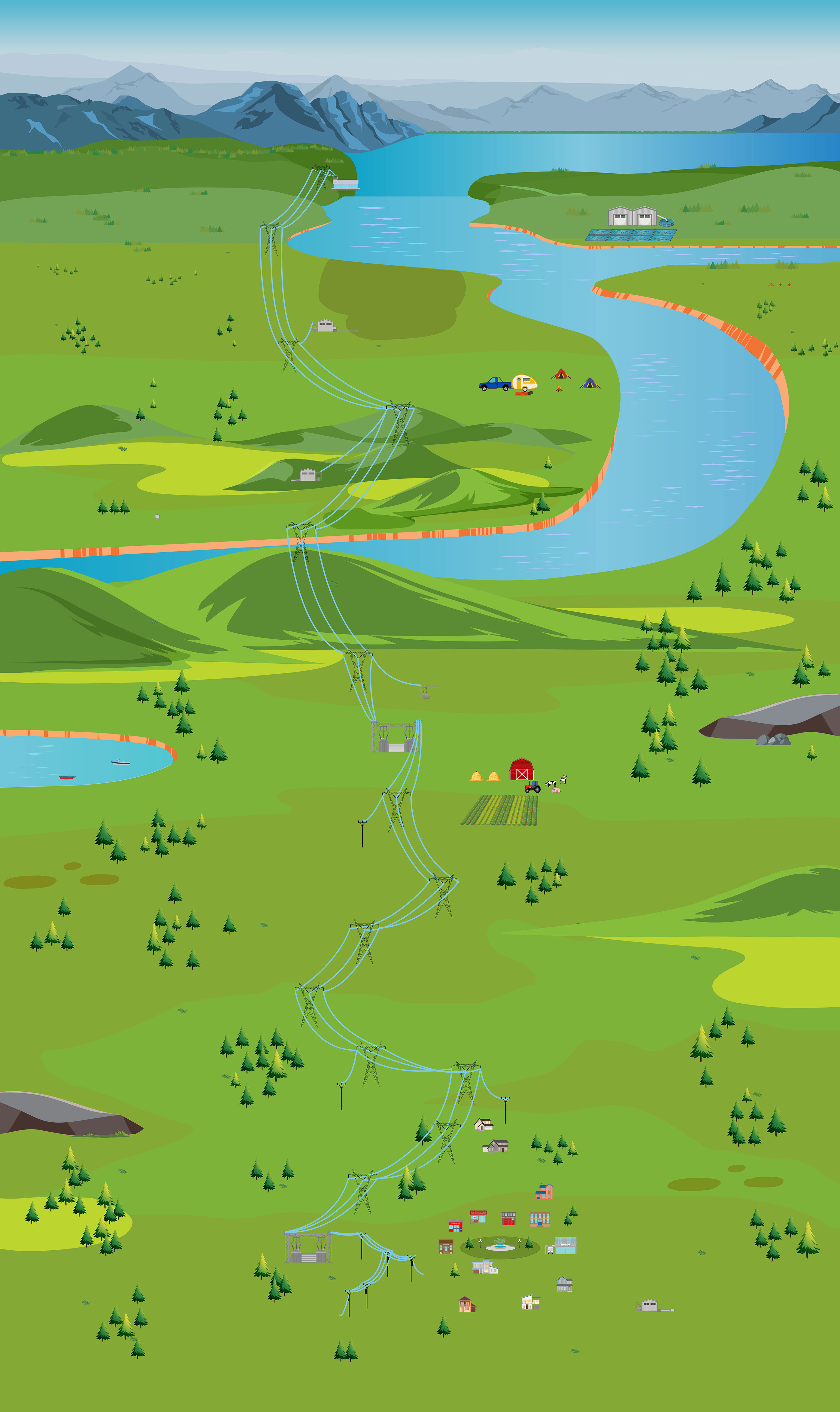
Washington is a growing community solar market with more than 30 solar farms in production and more coming online. Hydroelectric power
is a renewable power source that converts the kinetic energy of stored water to electricity using a turbine.
Hydroelectric dams create many opportunities, including recreation like camping, fishing, boating and more. Fish hatcheries have been in production in the Columbia River Basin since the late 1800s. There are at least 20 wind farms in Washington with more being planned. Biomass energy is considered a renewable energy source because we can grow more plants and trees. Manufacturing uses the largest amount of energy, followed by mining, construction and agriculture. The industrial customer uses energy for their processes, steam, co-generation, heating, cooling, and lighting. Farms are users of energy: pumps, tractors, cold storage, harvesting, maintaining crops and livestock all require energy. LEED (Leadership in Energy and Environmental Design) is used to rate buildings on their energy efficiency and cost savings. Call the Clark Public Utilities PowerLine at
360-992-8000 to report an outage
and receive up-to-date information.
Our crews prune trees back far enough so the power lines are free of tree contact until the next pruning cycle. In 2014 it was estimated the United States used 412 billion kWh of electricity just for lighting. One wind turbine can produce enough electricity to power up to 300 homes. Utility poles carry more than electricity - they also carry cable and telephone lines. The utility poles in neighborhoods can range in height from 30- to 60-feet tall. The larger ones you see along major roads and highways measure from 60 feet to more than 120 feet. Knowing how much energy you’re using and how much it costs is the first step in reducing wasted energy and lowering your monthly bill. The amount of voltage on a utility pole can range from a few thousand volts to 10,000 volts. Pole mounted transformers lower voltage so the right amount enters homes. Solar energy systems allow customers to generate a portion of the electricity they consume at their home or business while still remaining on the utility grid. Weatherizing your home can help to reduce the cost of heating and cooling. Heating and cooling a home makes up about 50% of an electric bill.
Map Pin Icon Clouds Image Wind Turbine Drawing Gif map pin 5 Solar Panel GIF Drawing Waste to Energy Plant Drawing Gif Factory Drawing Gif Factory Drawing Gif City Drawing Gif Shopping Center Drawing Gif Dam Froth GIF House Gif Drawing of apartments Hot Air Balloon Drawing Power Distribution Drawing

?

X

Questions?